August 2, 2024
Synthetic content and the Tetris effect.
The Cambrian explosion of generative artificial intelligence has pushed the content creation and consumption world to an inflection point. Like a digital Big Bang, GenAI has burst onto the scene, scattering foundation models and frontier models like seeds of simulated cognition enabling humans to create effortlessly. With a mere whisper of prompts, we can now produce high quality and high quantity content of any media form and any line of thought, once the exclusive domain of few chosen human minds.
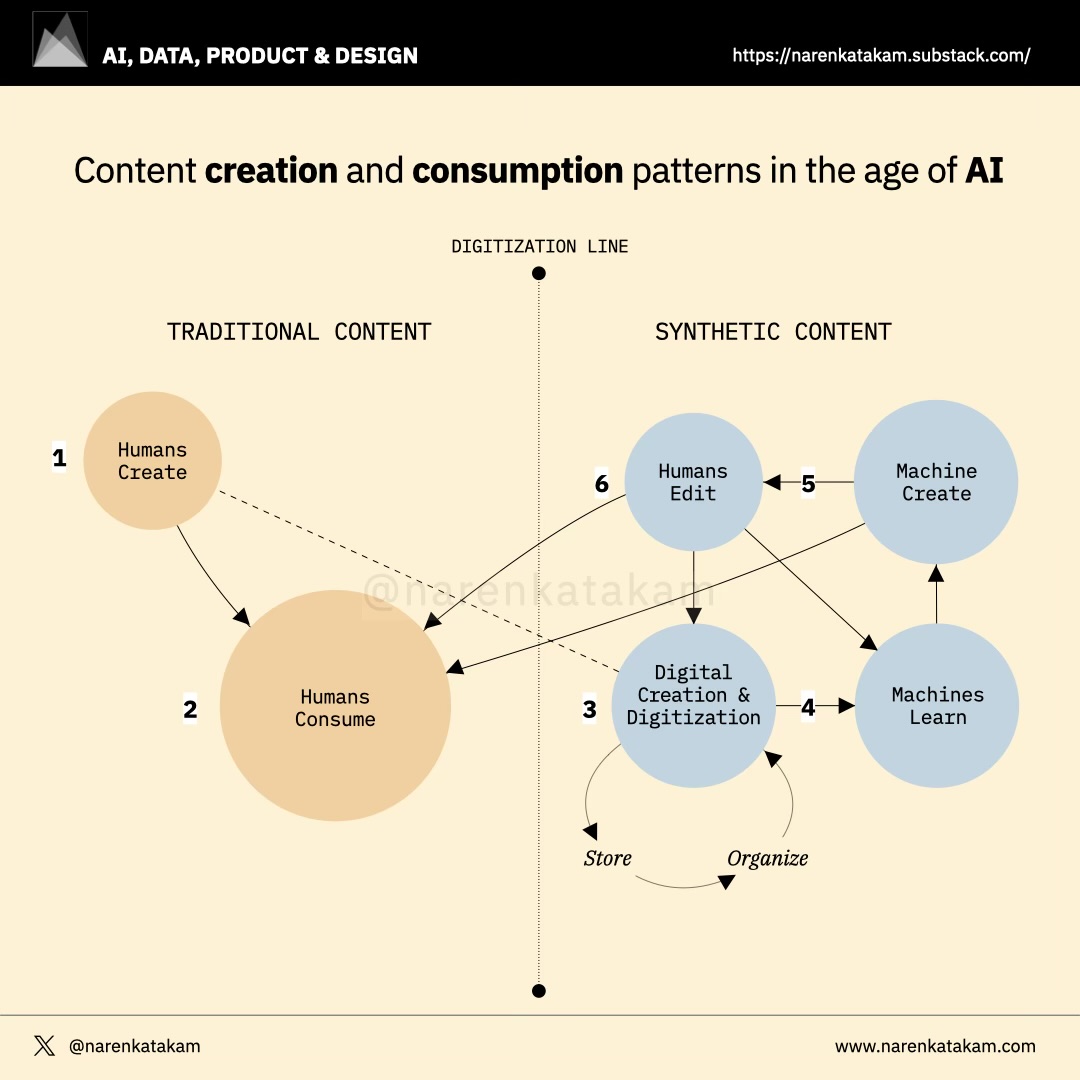
Things were simple back then. Slow, sure, but simple — humans created content laboring in a crucible of their own experiences and solitude. Other humans consumed this content, some got inspired, some even forwarded the line of thought into better versions of the originals. Some pivoted to different schools of thought extending, reaching and creating more interesting content. Some just devoured and consumed. This process continued for centuries, until Gutenberg’s printing press came along, only to accelerate the whole creation and the consumption loop.
Then there were computers, software and digitization processes of digitizing books and physical content to storing in digits and bits. Then internet and digitalization processes took over in organizing and extracting collective value out of the content. Now, we are in the age of AI.
Synthetic content proliferation:
The content creation process with AI looks somewhat like magic, effortlessly efficient and easy — we use prompts to generate, expand, and refine content across various mediums — text, images, video, and audio with ever-growing supply of awesome AI tools. We compile and edit the generated content to fit our needs and we publish on various platforms — Synthetic content. The published content or synthetic content becomes fodder for further AI training; it could be used to pre-train models or could be used in the fine-tuning process to make LLMs better — machines learn, iteratively, again and again on the previous content to a point where it gets difficult to distinguish an AI generated article, a photo, a video or an audio from a human created one.
We are just getting started in proliferating our digital worlds, our social media timelines with mixed content (human generated and synthetic or AI generated content). Projections suggest that by 2026, a staggering 90% of online content could be synthetic. Given the current pace of AI research and technological advancement, this milestone may arrive much sooner.
The incentives to generate synthetic content are aligned to benefit humanity in the short run but it will hurt us in the long run. The short-term gain may come at a significant long-term cost to our cognitive processes, social interactions, and fundamental understanding of truth. The human capacity for awareness and adaptation may struggle to keep pace with the relentless march of AI progress, driven by impetuous pursuit of efficiency and the ever-present human ambition to just grow at all costs.
Inertia of human awareness is not going to catchup with the gravity of human greed.
The cognitive patterns we develop in response to synthetic content could extend beyond our digital interactions, influencing our approach to real-world problems and social dynamics. As the boundaries between human-created and AI-generated content blur, we may find ourselves unconsciously applying the logic and patterns of synthetic information to our everyday lives — like trying to make sense of falling Tetris blocks with missing slots on the floor.
The Tetris effect:
Our digital content world has already started looking like Tetris blocks. Take a look at any social media timelines — How much of that content is human generated vs. AI generated? Can you discern with confidence?
We may currently possess the ability to discern between what we perceive as ‘real’ and what it seems AI-generated, this distinction is rapidly blurring (50% of consumer can spot AI-generated copy). As machine learning progresses at a breakneck pace, synthetic content increasingly dominates our digital experiences and interactions, from timelines to swipes, we face the prospect of a profound shift in our cognitive processes — enter the Tetris effect.
The Tetris effect, named after the iconic puzzle game, illustrates how immersive experiences can reshape our perception of reality. Players who engaged with Tetris for extended periods found themselves perceiving the world through the lens of the game, envisioning how objects in their environment might fit together, mirroring the game’s mechanics. This phenomenon extends beyond mere visual patterns, potentially altering thought processes, dreams, and even decision-making patterns.
As synthetic content population is accelerating our digital spaces, we must consider the profound implications it might have on our collective human cognition, macro and micro behavior patterns. Our addictive urge to ‘fit’ digital experiences into our real-world perceptions raises important questions: How will this constant exposure alter our perception of reality? Will our brains seamlessly adapt to integrate the virtual and the real worlds? Or will it struggle to maintain distinction between the two? How will this affect our interpersonal relationships, our trust in information sources, and our very concept of authenticity? With dwindling trust patterns, would we be able to form deep, meaningful connections with the world around us?
As we immerse ourselves in synthetic content, we grapple with a fundamental philosophical quandary: What constitutes ‘real’ in a world dominated by AI-generated information? If the data used to train and refine AI models is predominantly synthetic, we risk creating a self-referential loop of artificial information, potentially distancing ourselves from authentic human experiences and genuine creativity.
We should focus on its impact on our personal and collective cognitive and explore its potential for both positive and negative impacts on creativity, critical thinking, problem-solving capabilities, and emotional intelligence. The future will undoubtedly be a complex interplay of the virtual and the real worlds, but by remaining vigilant and adaptable, we can ensure that this fusion enhances our human experience rather than diminishes it.
References:
-
https://futurism.com/the-byte/experts-90-online-content-ai-generated
-
https://www.bynder.com/en/press-media/ai-vs-human-made-content-study/