August 7, 2024
From Chaos to Clarity: Crafting a Comprehensive AI Strategy - Part 1
Welcome to the world of AI, Data, Product & Design!
I’m Naren, and each week, I distill years of my experience into actionable insights for product managers and product designers with data and AI interests.
In a very short span of time, artificial intelligence (AI) has rearranged our lives in astonishing and unimaginable ways. This is one of those instances where technological capability was achieved much ahead of the need or use case maturity.
With lightning-fast processors crunching data and training models at unprecedented speeds, and algorithms clever enough to give Einstein a run for his money, AI’s potential is vast and transformative for any enterprise.
To adapt and thrive as an enterprise in such a fast-changing environment, it is essential to have a lucid and tenacious AI strategy first and then execute it to improvise internally (business processes) and externally (offer competitive products or services to the market).
What is AI Strategy?
The purpose of any strategy is to bring clarity.
A simple and clear plan that outlines how an enterprise intends to leverage artificial intelligence to achieve its business goals is AI strategy.
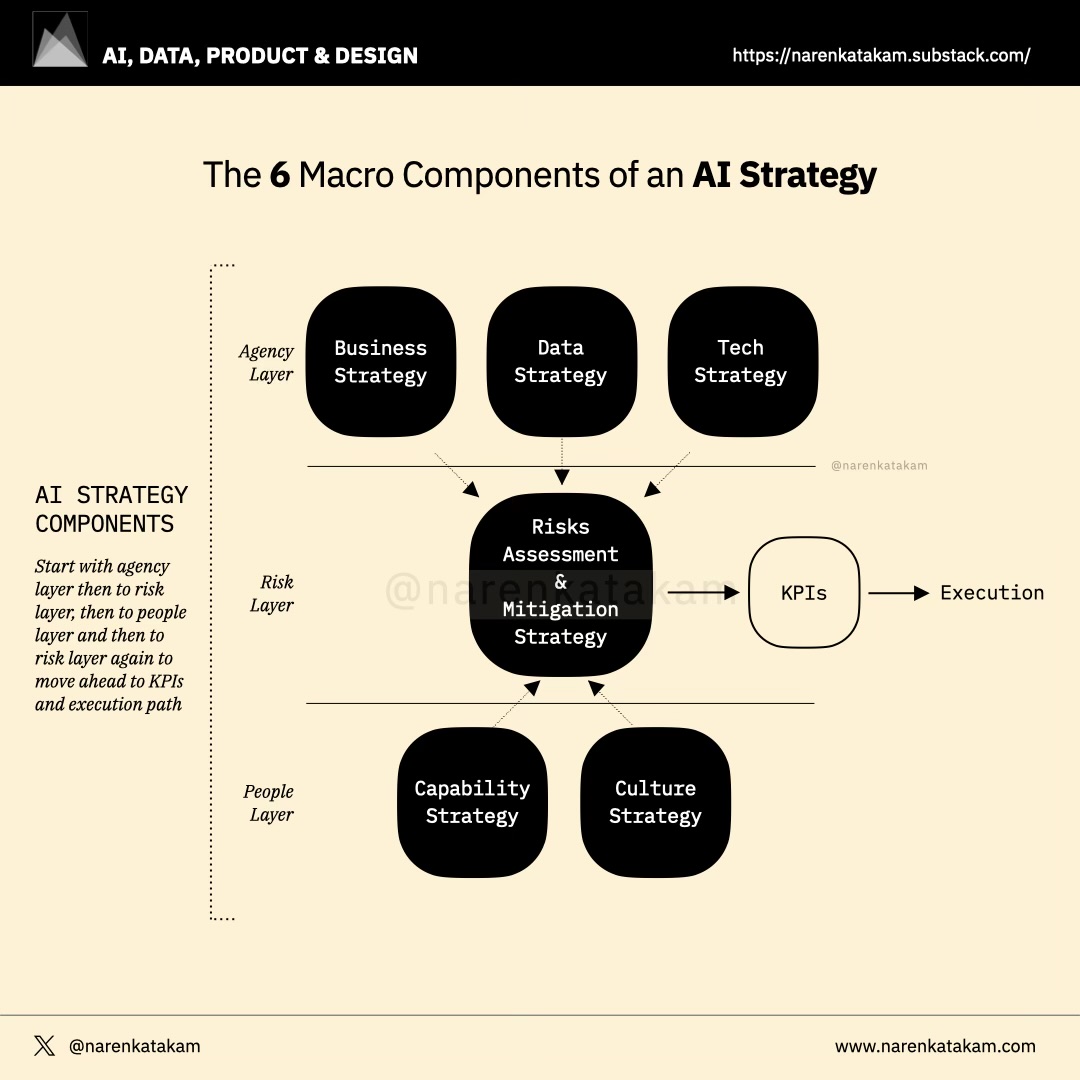
There are six macro clarity components of an AI strategy, maybe they can be broken down further or maybe they can be consolidated into three layers of focus. However you slice them or view them, here’s a perspective from different layers:
Agency layer:
-
Clarity on Business Objectives: The first step in developing an AI strategy is to get clarity on the business objectives. What does the company hope to achieve? How can AI play a role in that?
Business objectives could range from providing better customer service to automating and optimizing business processes, accelerating decision making processes, enhancing product development, or even expanding into adjacent markets and creating new revenue streams.
Getting clarity on what business wants to achieve is imperative. Then comes the role of AI. How can AI help business achieve its goal cheaper, faster and better? -
Clarity on Data Strategy: Data is the lifeblood of AI. It is crucial to determine whether the business has the right data to build and support accuracy and efficacy of models. Is the data readily accessible, of high quality, and relevant to the business problem?
An AI strategy must be built on a robust data strategy that details how data is collected, processed, stored, and consumed. It’s advisable for the organization to begin collecting data as a foundational step, even before developing any machine learning models.
A significant aspect of your AI model’s performance depends on the data preparation conducted before training the models. Ensuring high-quality data and proper validation processes is crucial, as they form the foundation for successful model outcomes. The final step in the pipeline is feeding the prepared data into the model.
If the data is of poor quality or lacks adequate validation, the model’s results are unlikely to be accurate or effective. Therefore, meticulous attention to data quality and validation is essential for achieving positive and reliable outcomes.
Data strategy also includes establishing comprehensive data governance policies to ensure data privacy, security, and compliance with relevant regulations. Additionally, considerations should be made for data integration, scalability, and the infrastructure needed to support data analytics and machine learning workflows. -
Clarity on Tech Strategy: The availability of the right technology stack is crucial. Taking the right steps early and moving away from legacy systems is a critical component of the tech readiness journey. This includes selecting appropriate data storage solutions, computational power, and machine learning frameworks that support innovation.
The technology stack should be flexible enough to accommodate evolving AI techniques and scalable to handle increasing data volumes.The Buy Vs Build Question: An organization’s decision to build in-house or buy from providers depends on its existing capabilities, resources, and business need.
While building in-house requires significant commitment, it ensures that the organization learns and advances its AI expertise over time. This approach can be particularly beneficial for organizations looking to stay competitive in the long term.
While buying, organizations can build bespoke AI solutions with a partner, a AI development service provider or buy an out-of-the-box solution from a provider. Alternatively organizations can pursue strategic acquisition of other companies/startups. Acquisition strategy not only enhances AI capabilities but can also help maintain market leadership by neutralizing potential competitors.
Risk layer:
- Clarity on Risks: Risk is critical to manage for any project, and this is especially true for AI projects. Unlike traditional software projects, which benefit from predictability due to established methodologies and accumulated experience, AI projects are inherently more uncertain due to the stochastic nature of AI algorithms and output.
AI initiatives encompass a range of inherent risks, including ethical concerns related to fairness and transparency, security vulnerabilities that could expose sensitive data or systems to malicious attacks, and the potential for biases embedded in algorithms that can lead to unfair outcomes. Therefore, a comprehensive AI strategy must include a detailed risk management plan that specifically addresses these issues.
People layer:
-
Clarity on Capabilities: AI projects require specific skilled personnel, technological infrastructure, and financial investment — this collectively defines an organization’s capability to develop and deploy AI projects.
An effective AI strategy assesses and allocates required resources efficiently, ensuring that the company can develop and deploy AI solutions at scale. AI projects require specialized skills, from AI product managers, data scientists and machine learning engineers to domain experts.
The strategy should outline how the company plans to attract, retain, and develop AI talent or partner with solution providers or acquire and merge with AI startups. -
Clarity on Culture: Integrating AI into a business is not just a technical challenge; it’s also a people challenge; it requires a shift — a shift in thinking. Integrating AI into a business is not just a technical challenge; it’s also a people challenge; it requires a shift — a shift in thinking.
Educating employees on data and AI technologies and organizing learning bootcamps and workshops, empowers employees to contribute actively to the organization’s AI strategy.
Enhancing data and AI literacy helps alleviate fears of job displacement by showing employees how AI can enhance their roles and foster a collaborative work environment. This fosters a culture of AI adoption, which is essential for broad organizational integration.
Continuous employee training is crucial, as AI technologies evolve rapidly. A culture of ongoing education keeps employees engaged and facilitates a smooth transition overcoming resistance to change and ensuring the successful AI adoption.
Approach Selection Caveat:
AI strategy can be approached in three distinct ways. The first is the comprehensive approach, which involves developing a detailed and all-encompassing strategy from the outset; which I’ve tried to describe swiftly in the post above. This approach works for mid level to massive organizations with low innovation rate and poor product experimental setup.
The second approach is the thin-slice or incremental approach. This involves starting from the use cases, finding low-hanging fruits that provide most value and gradually expand as more knowledge and experience are gained through experiments. The idea here is to learn and improve. This approach works well for small organizations; it allows for flexibility and the opportunity to adjust strategies based on real-world outcomes and insights.
The third option is a balanced middle path that combines elements of both the comprehensive and incremental approaches. It starts with a focused, thin-slice strategy by selecting specific business and data areas to explore. Organizations can quickly implement AI solutions, find ripe use cases, gain practical experience and insights. This experience then informs the development of a more comprehensive AI strategy as the organization becomes more confident and capable in its AI experiments. This approach is ideal for small to mid-level organizations with some level of product experimental frameworks in place.
The choice depends on individual teams and organizations and oscillate around several other factors, including the organization’s maturity level, technological and data readiness, and cultural alignment with AI adoption.
Thank you for diving into the world of AI, Data, Product & Design with me!
If you’ve enjoyed reading this content and haven’t subscribed yet, I invite you to join our growing community.
By subscribing, you’ll receive fresh insights delivered straight to your inbox, typically on a weekly basis.
Until next time, may your week be productive and your weekend rejuvenating.
Your curiosity fuels this space – keep exploring, keep innovating!
- Naren
P.S. Have thoughts or questions? Hit reply – I’d love to hear from you!
This post is public so feel free to share it.