February 15, 2026
The AI Productivity Trap: Why Automation Creates More Work Before It Eliminates It
As someone working in technology, I’ve witnessed a repeating pattern with almost eerie precision: smart teams adopt major new workplace tools with excitement, get buried under them within weeks, then either push through to something better or quietly declare the experiment a failure.
What Is the AI Productivity Trap?
A senior executive recently told me his AI transformation was going great. His team had integrated GPT-5 into their content pipeline, automated customer research, and built AI-assisted code reviews. His employees were now working 12-hour days.
He said this with a straight face.
That’s not a failure story — it’s the most predictable outcome in workplace automation history. Every transformative technology follows the same arc: it promises to eliminate work, then temporarily multiplies it before creating either failure or progress.
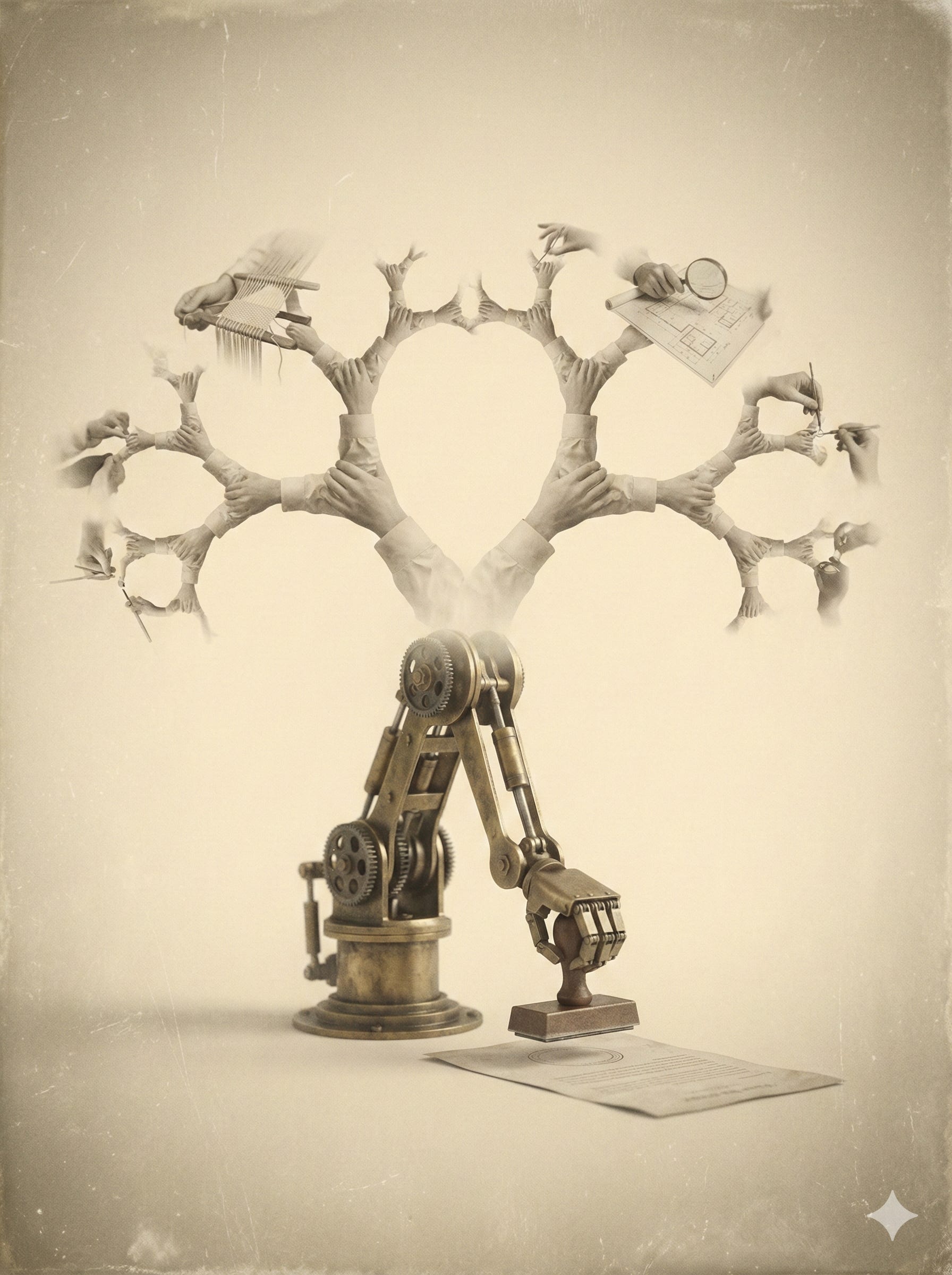
We’re deep in what I call the multiplication phase — when every automated task spawns two or three new ones requiring management. The chatbot generates responses, but someone reviews them for brand voice. AI writes code, but someone audits it for security. The algorithm identifies leads, but someone crafts follow-ups that don’t sound robotic.
Most people assume this multiplication signals failure. I disagree. The multiplication isn’t the bug. It’s the mechanism. When you automate routine job components, you don’t just free up time — you expose complex, messy, judgment-heavy work hiding underneath. We become editors, interpreters, handlers of the unpredictable.
This is the productivity valley — as inevitable as gravity.

Why This Should Matter to You Right Now
Organizations winning the AI transition aren’t those with the most sophisticated tools. They’re the ones who prepared for the valley before reaching it.
Most organizations budget for AI like any other software: expect immediate returns, measure success quarterly, assume progress moves linearly. When productivity metrics look worse after three months, the instinct is questioning the investment, not the linear thinking.
This creates three failure modes:
The team burnout. When best people find themselves working longer hours after an “efficiency upgrade,” they don’t want to stick around. You risk burning capable people at the exact moment you need them most.
The investment panic. Three months in, when metrics look worse, boards ask uncomfortable questions. Projects get cut. Budgets shrink. Organizations retreat to familiar ground. It’s like training for a marathon, quitting at mile 4, and concluding running doesn’t work.
The complexity trap. Without acknowledging the valley, organizations layer new AI tools onto existing workflows instead of redesigning them. Each automation creates more handoff points, quality checks, and exceptions. You end up with both old complexity and new overhead — the worst of both worlds.
Companies successfully navigating the productivity valley will have rebuilt themselves around human-AI collaboration in ways competitors simply cannot replicate. Others will fight yesterday’s battles with yesterday’s tools, wondering why the gap widens.
How to Navigate Through It (Without Burning You Out & Your Team)

Smart organizations treat the productivity valley like a construction project, planning for disruption because they’re building something permanent. The building site always looks worse than the parking lot it replaced — but that’s not a reason to stop building.
→ Reframe your metrics from day one.
Stop measuring immediate productivity gains. Track the right metrics instead. The question isn’t “How many more blog posts did we publish this week?” It’s “How many readers are bookmarking our content more?” The valley is where you build muscle. You don’t expect peak performance on the first training day, so don’t expect it from your team either.
→ Design transition workflows explicitly.
Create clear handoff protocols between AI and human workflows during the learning phase. When AI generates customer responses, build a systematic human-centered review process capturing what it missed and feeding that learning back. These workflows are scaffolding — existing to be torn down once AI and your team genuinely learned collaboration. Still running them a year later? That’s a signal something’s wrong.
→ Tell your team the truth — all of it.
Don’t promise efficiency and deliver longer hours. Tell them upfront: “For the next six months, we’re going to work harder teaching these systems. We’re not just automating tasks — we’re elevating team capability.” Make them architects of the future state, not victims of the current mess. How people show up to those two framings differs significantly.
→ Stage your rollout like you mean it.
Don’t implement AI across all functions simultaneously. Pick one area with less ambiguous, well-understood workflows. Take it through the complete valley journey. Learn everything possible. Then apply lessons to the next area. Early adopters become internal consultants. Momentum compounds. Mistakes get cheaper.
Key Takeaways
- The valley is structural, not accidental. You will hit it. The question is whether you hit it prepared or surprised.
- The multiplication of work is the mechanism, not malfunction. Automation surfaces complexity. That’s the point. Now you design for it.
- The human role doesn’t shrink — it shifts. AI handles the predictable. Humans get everything that isn’t. That’s not a threat. That’s a promotion, if you frame it right.
And Finally — What the Valley Is Actually Telling You
We are not task-completers waiting to be automated away. We’re sense-makers, relationship-builders, creative problem-solvers who get better tools and immediately find bigger problems to solve. The more you automate, the more you discover what was never automatable.
The valley isn’t where productivity dies. It’s where human potential multiplies.
The biggest restriction in any AI transformation isn’t technology, budget, or roadmap — it’s the assumption that the dip means something went wrong. It didn’t. It means something is beginning.