March 30, 2026
30 Days Learning Curve With Claude Code
About a month ago, I switched to Claude as my primary go to AI tool.
I’m not a developer by training. I’m a product person — systems thinker, designer, mechanical engineer turned tech consultant. I know what things should do and why. The how is where I’ve always needed a team. Claude is slowly becoming that team.
After 30 days of intensive use — building a personal website with an agentic AI layer with an MCP server, creating design skills, setting up automated workflows, shipping actual products — I noticed something interesting about my usage pattern. Something that I think applies to anyone picking up this tool seriously.
The Smile Curve
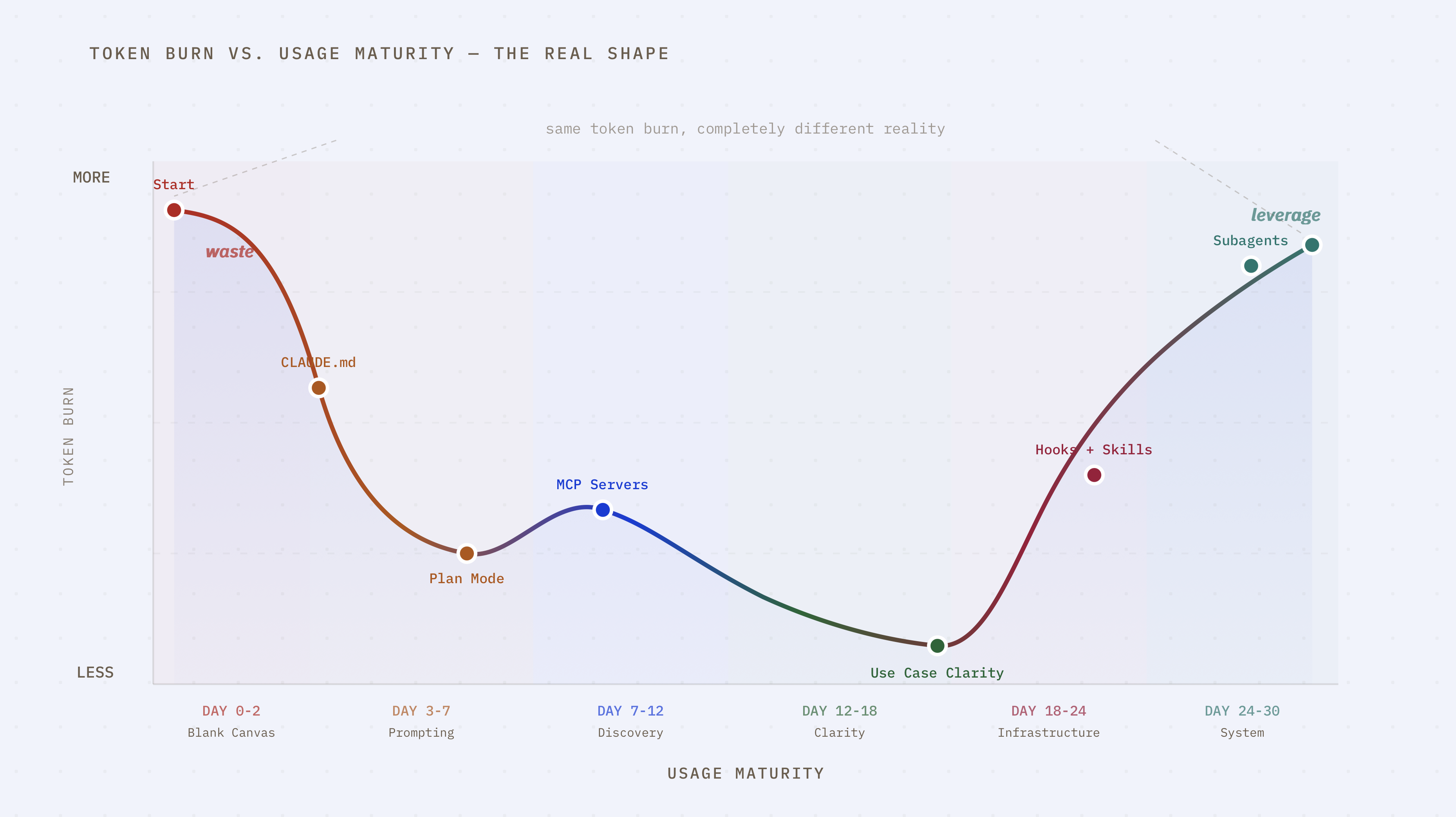
I was looking at my token usage one afternoon and noticed it follows a pattern that looks like a smile. A U-curve. You start by burning a ridiculous amount of tokens — wasted effort, going in circles, re-explaining yourself. Then you get efficient and the burn drops. Then, and this is the part that surprised me, it goes back up.
But here’s the thing about that second rise. It’s a completely different animal.
Day 2 tokens are you, repeatedly explaining who you are, what you want, and how you think — orientation problem. Day 25 tokens are an army of subagents autonomously researching, building, and testing — while you decide what to work on next.
Same metric. Completely different reality.
Not a Curve. A Staircase.
When I zoomed in closer, the curve wasn’t actually a smooth U. It was a staircase. A series of plateaus punctuated by sudden level-changes. Each step corresponded to a specific unlock — a moment where something clicked and my entire relationship with the tool shifted.
Here are the six phases I went through. If you’re starting out, you might recognise yourself in one of them.
PHASE 1 · DAYS 0–2
The Blank Canvas
I started intentionally with no CLAUDE.md — the configuration file that tells Claude who you are and how you work. No structure. Every single conversation starts from absolute zero. You’re explaining your role, your preferences, your project, your coding style — over and over. It’s like having a brilliant new colleague with amnesia.
Token burn: astronomical · Value: low
PHASE 2 · DAYS 3–7
Prompting Maturity
You write your first CLAUDE.md. This is the single highest-leverage moment in the entire 30 days. Suddenly the tool knows who you are, what you care about, how you think. Conversations stop being repetitive. You learn that how you ask matters as much as what you ask.
The drop in token burn here is dramatic. It’s like the difference between giving directions to someone who has a map versus someone who doesn’t even know what city they’re in. You see the value and you keep tinkering to make your CLAUDE.md file the best version of it self.
Token burn: dramatic drop · Biggest single unlock
PHASE 3 · DAYS 7–12
Tool Discovery
You discover plan mode. Slash commands. Connecting to various MCP servers based on your use cases (mine started with Figma). The token burn fluctuates because you’re experimenting — some experiments are efficient, others are spectacular wastes. But each experiment teaches you what the tool can and can’t do.
This is also where you feel the first hints of something powerful. Not just “AI that writes code” but “AI that can think about how to approach a problem before writing code.” Plan mode was that revelation for me.
Token burn: fluctuating · Experimenting
PHASE 4 · DAYS 12–18
Use Case Clarity
The valley. The most token-efficient phase. You’ve stopped trying to use Claude Code for everything and started using it for the things it’s genuinely exceptional at. Multi-file refactors, research synthesis, architectural reasoning. You’ve developed taste about when to use it and when to just open a terminal and type the command yourself.
Token burn: valley floor · Maximum efficiency
PHASE 5 · DAYS 18–24
Infrastructure Build
This is where it gets interesting. Token burn starts climbing again, but the nature of the work shifts entirely. You’re no longer doing tasks — you’re building systems.
Hooks that auto-audit every npm package before installation. Skills that encode your design principles so the AI applies them consistently. Memory systems that carry context across conversations. CLAUDE.md files that are now 200+ lines of carefully tuned behavioral instructions - each character earns its place.
You’re essentially programming the programmer.
Token burn: rising · Investment, not waste
PHASE 6 · DAYS 24–30
System Maturity
The second peak. Token burn is high — much higher than Day 1. But look at what’s burning them: subagents running in parallel, automated research pipelines, agentic workflows that trigger other workflows. You’ve gone from “person typing prompts” to “person directing an autonomous system.”
You are doing less but more is getting done — that’s the definition of leverage.
Token burn: high · Pure leverage
The Insight Nobody Mentions
Here’s what I wish someone had told me on Day 1: the learning curve for Claude Code is not about learning to prompt better. That’s the surface-level story. The real learning curve is about something much more fundamental.
It’s about learning to think in systems again.
As a product person, I think in systems all day. Feedback loops, emergent behavior, second-order effects. But when it came to development tools, I’d been trained to think linearly: write code, run code, fix code, repeat.
Claude Code broke that pattern. By Day 20, I wasn’t thinking about code at all. I was designing behaviors, encoding preferences, building feedback loops between my intent and the tool’s execution. The CLAUDE.md file isn’t a configuration document — it’s a specification for a collaborator’s behavior. The memory system isn’t a database — it’s an organizational nervous system that compounds learning across sessions.
The real story isn’t “AI writes code faster.” That’s table stakes and, frankly, it’s boring. The real story: for the first time, a non-developer can architect, build, and ship production systems by focusing entirely on what and why, while the tool handles the how.
What I’d Tell You on Day 1
If I could hand you a cheat sheet on Day 1, it would say this:
-
Write your CLAUDE.md immediately. Don’t wait until you “know the tool better.” Tell it who you are, what you value, how you want to be communicated with. This is the highest-leverage 30 minutes you’ll spend.
-
The goal is not fewer tokens. It’s more leverage per token. A session where you burn 500k tokens but ship a production feature with tests and automated deployment is infinitely more valuable than a session where you burn 10k tokens asking it to explain a regex.
-
Every correction is a compound investment. When you correct the tool and it saves that correction for next time, you’ve just made every future session slightly better. This is compounding at work. Don’t skip corrections because they feel tedious — they’re the highest-interest deposits you can make.
-
Build the system, not the output. The moment I stopped asking Claude Code to “do tasks” and started asking it to “build systems that do tasks,” everything changed. Skills, hooks, memory, delegation templates — these are the infrastructure. The code is the output.
-
Think in phases, not linear progress. You will feel like you’re getting worse before you get better. The Infrastructure Build phase feels like regression — you’re spending time on “meta work” instead of “real work.” It’s not regression. It’s laying the foundation for Phase 6, where you get more done in a day than you did in your first week.
Most people use AI coding tools as a quick fix. Type a prompt, get code, paste it, move on. It works. But it never compounds. Every session starts from zero. You’re stuck on the treadmill of prompting.
The alternative — the fundamental fix — is to invest in the system. Teach the tool who you are. Build the infrastructure. Encode your thinking into something persistent. It’s slower on Day 3. It’s dramatically faster on Day 30.
The learning curve for Claude Code isn’t about the tool at all. It’s about you. How quickly you stop thinking of it as a tool and start thinking of it as a system. That shift — from tool to system — is where the real leverage lives.
And the beautiful thing? The system gets smarter every time you use it. Not because of some magical AI improvement. Because you built it that way.
If this sparked something:
If you’re not subscribed yet — this is where I think out loud about product, AI, and the way intelligent systems are being built. And occasionally what I learn through building.
If this made you think of someone — a PM, an engineer, a founder building anything with AI — forward it. One good forward beats a hundred passive reads.
And if you want shorter takes between essays,
I’m on X at @narenkatakam. Same brain, faster loops.
More of what I work on at narenkatakam.com.